
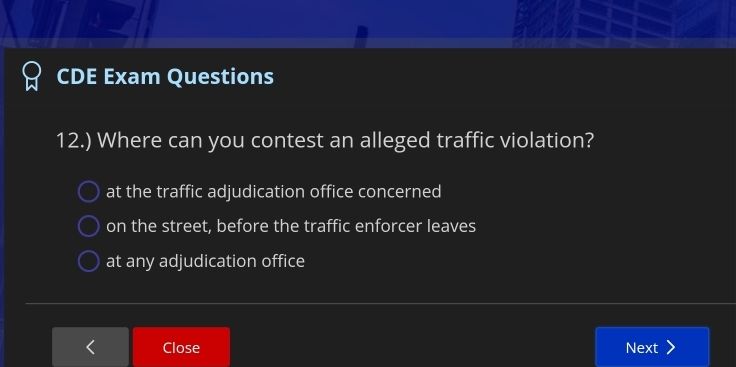
CDE Exam Question: Where can you contest an alleged traffic violation?
- A. At the traffic adjudication office concerned
- B. On the street, before the traffic enforcer leaves
- C. At any adjudication office
The correct answer is A — at the traffic adjudication office concerned. Philippine traffic law requires motorists to file their contest at the specific adjudication office that has jurisdiction over the violation, not at a random office or on the roadside. This ensures the proper records, the issuing officer’s report, and the relevant evidence are all accessible during the hearing.
Why the Traffic Adjudication Office Concerned Is Correct
When a traffic enforcer issues a citation, the case is filed under the adjudication office that covers the area or agency where the violation was recorded. That particular office holds the original ticket, the enforcer’s written report, and any photographic or electronic evidence. Contesting the violation there guarantees you appear before the hearing officer who actually has authority over your case. Under Republic Act No. 4136 (the Land Transportation and Traffic Code) and the guidelines of the Land Transportation Office (LTO) and the Metropolitan Manila Development Authority (MMDA), adjudication proceedings are venue-specific — much like how a court case must be filed in the correct jurisdiction.
Practically, this also means the traffic enforcer who flagged you can be summoned to testify if needed, because the office is within their operational zone. Filing at the wrong office would result in your contest being redirected or dismissed outright, wasting time.
Why the Other Options Are Wrong
Option B — “On the street, before the traffic enforcer leaves” is the most tempting wrong answer. Many drivers instinctively argue with the enforcer on the spot. However, a traffic enforcer on the road is not a hearing officer. They have no authority to adjudicate or dismiss a citation they just issued. Debating on the street can even escalate the situation and lead to additional charges such as obstruction or resistance to a person in authority. The proper venue for a contest is always a formal adjudication proceeding, never the roadside.
Option C — “At any adjudication office” sounds reasonable but misses a key detail. Adjudication offices are not interchangeable. Each office handles violations that fall within its jurisdiction — MMDA offices handle MMDA-issued tickets, LTO offices handle LTO citations, and local government traffic offices handle locally issued ones. Walking into an unrelated office with your ticket will simply get you redirected to the correct one. The word “concerned” in Option A is the critical qualifier that makes it accurate.
How the Traffic Adjudication Process Works
After receiving a traffic violation ticket (TVT), a motorist typically has a set number of days — often 15 calendar days for MMDA violations — to either pay the fine or contest it. To contest, you visit the adjudication office named on the ticket, fill out a contest form, and submit any supporting evidence such as photographs, dashcam footage, or witness statements. A hearing officer then reviews both the enforcer’s report and the motorist’s defense before rendering a decision. If the motorist disagrees with the outcome, an appeal may be filed with a higher authority depending on the issuing agency’s rules.
Knowing this process matters beyond the CDE exam. Drivers who miss the contest window may lose the right to dispute the violation entirely and face escalating penalties, including a hold on license renewal.
Quick Tip to Remember the Answer
Focus on the word “concerned” — it tells you the answer is about a specific, relevant office, not just any office and certainly not the street. Whenever a CDE question asks where can you contest an alleged traffic violation, think “right place, right records.” The office that issued the ticket is the only one with your file, so that is where your contest must go. A simple memory hook: your ticket has an address — that address is your answer.
