
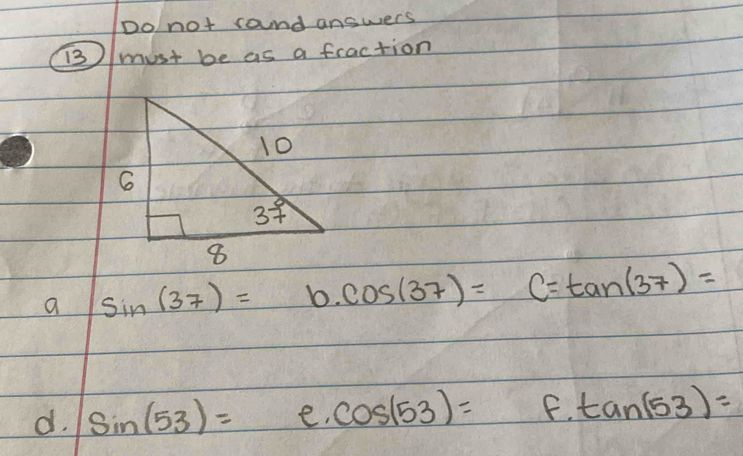
Question: Do not round answers. Write as a fraction. a) sin(37°) = ? b) cos(37°) = ? c) tan(37°) = ? d) sin(53°) = ? e) cos(53°) = ? f) tan(53°) = ? The correct answer is a) sin 37° = 3/5, b) cos 37° = 4/5, c) tan 37° = 3/4, d) sin 53° = 4/5, e) cos 53° = 3/5, f) tan 53° = 4/3. These values come from the classic 3-4-5 right triangle where 37° and 53° are complementary acute angles, so sin 37 in fraction is exactly 3/5 when not rounded or approximated with a calculator.
Why the Fractions 3/5, 4/5 and 3/4 Are Correct
The fractions are correct because 37° and 53° are treated as the acute angles of a 3-4-5 right triangle, a standard exact-value triangle used in textbooks. In a right triangle, sin = opposite / hypotenuse, cos = adjacent / hypotenuse, tan = opposite / adjacent.
Take a right triangle with legs 3 and 4 and hypotenuse 5. The angle opposite the side of length 3 is approximately 37°, the angle opposite the side of length 4 is approximately 53°. This is not exact in real trigonometry — true sin 37° is about 0.6018 — but in middle-school and high-school exact-value exercises, 37° is defined as the 3-4-5 angle for simplicity.
So for the 37° angle: opposite = 3, adjacent = 4, hypotenuse = 5. Therefore sin(37°) = 3/5 = 0.6, cos(37°) = 4/5 = 0.8, tan(37°) = 3/4 = 0.75. For the 53° angle the sides swap: opposite = 4, adjacent = 3, hypotenuse stays 5. Therefore sin(53°) = 4/5, cos(53°) = 3/5, tan(53°) = 4/3.
This also shows complementarity: sin(37°) = cos(53°) and cos(37°) = sin(53°) because 37° + 53° = 90°. In any right triangle, the sine of one acute angle equals the cosine of the other.
Why Other Values Would Be Incorrect
Any decimal approximation like 0.60 or rounded calculator value is incorrect here because the instruction says do not round and must be as a fraction. Other fractions such as 3/4 for sin 37° or 5/3 for tan 53° confuse opposite, adjacent, and hypotenuse.
Common mistakes:
- Using sin 37° = 3/4: This confuses sine with tangent. 3/4 is tan 37°, not sin. Sine must have hypotenuse 5 in denominator.
- Using sin 37° = 4/5: This swaps the two acute angles. 4/5 is sin 53° and cos 37°, the side opposite the larger angle.
- Using tan 53° = 3/4: This inverts tan 53°. Since tan = opposite/adjacent, for 53° it is 4/3, not 3/4. 3/4 is tan 37°.
- Using values like 0.6018 or 3.5/5: These are calculator-approximated sines, not the exact 3-4-5 fractions the exercise expects. The exercise treats 37° and 53° as idealized angles, not true measured degrees.
The most confusing pair is sin 37° = 3/5 versus sin 53° = 4/5. Students often memorize one without linking to the diagram. Remember: the smaller angle (37°) is opposite the shorter leg (3), so its sine is smaller (3/5).
How to Remember These Fractions Quickly
Remember the 3-4-5 triangle and the phrase small angle — small side. 3 is the smallest side, 4 is middle, 5 is hypotenuse.
For 37° (small angle): sin = 3/5, cos = 4/5, tan = 3/4. For 53° (larger angle): flip 3 and 4 — sin = 4/5, cos = 3/5, tan = 4/3. Check with two rules: sin² + cos² must equal 1 — (3/5)² + (4/5)² = 9/25 + 16/25 = 1 — and tan = sin/cos — (3/5)/(4/5) = 3/4.
If a future problem asks for sin 37 in fraction with decimals, first check if it allows approximation or requires the exact 3-4-5 value. If it says do not round or use exact value, use 3/5; if it says use calculator, use about 0.602.
