
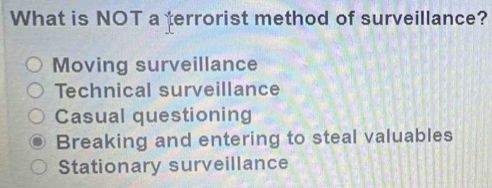
What is NOT a terrorist method of surveillance?
- A. Moving surveillance
- B. Technical surveillance
- C. Casual questioning
- D. Breaking and entering to steal valuables
- E. Stationary surveillance
The correct answer is D. Breaking and entering to steal valuables. This activity is a common criminal offense motivated by personal gain — theft — rather than a recognized method terrorists use to gather intelligence on a target. All four remaining options describe established surveillance techniques documented in antiterrorism and force-protection training.
Why Breaking and Entering to Steal Valuables Is the Correct Answer
Terrorist surveillance has a single purpose: collecting information that helps plan, rehearse, or execute an attack. Every genuine surveillance method — whether stationary, moving, technical, or conversational — is designed to observe a target without drawing attention and without leaving evidence of the observation itself. Breaking and entering to steal valuables fails both tests. It is loud, leaves physical evidence (forced locks, broken windows, missing property), and its goal is acquiring material goods, not intelligence. A burglar wants a television; a terrorist conducting pre-attack surveillance wants guard-rotation schedules, camera blind spots, and building layouts.
That distinction matters. U.S. Department of Defense antiterrorism awareness programs (commonly known as Level I Antiterrorism training) list specific indicators of terrorist pre-operational surveillance. Property theft for personal enrichment is never among them. When terrorists do break into a facility, the objective is typically to plant listening devices, copy documents, or photograph floor plans — activities categorized under technical surveillance or covert entry for intelligence, not theft of valuables.
Why the Other Options Are Recognized Surveillance Methods
Moving surveillance (Option A) involves following a target — a person, vehicle, or convoy — along a route to map daily patterns, identify chokepoints, and time security responses. Terrorists commonly use single or multiple operatives on foot or in vehicles to track military personnel, diplomats, or high-value civilian targets over days or weeks.
Technical surveillance (Option B) covers any technology used to observe without physical proximity: cameras, drones, GPS trackers, laser microphones, hacked CCTV feeds, or even publicly available satellite imagery. This method lets operatives gather detailed information while remaining far from the target site.
Casual questioning (Option C) is the option most people second-guess. It sounds harmless — a stranger asking a security guard what time shifts change, or a “tourist” asking which gate delivery trucks use. Yet antiterrorism training specifically flags casual questioning as a key pre-attack indicator. Terrorists blend questions into normal conversation so the person answering never realizes they just revealed operationally useful information. If you hesitated between C and D, you are not alone; C is the most common trap answer on this question.
Stationary surveillance (Option E) means watching a target from a fixed position — a parked car, a rented apartment overlooking a compound, a bench near a building entrance. It is one of the oldest and simplest intelligence-gathering techniques, used to log foot traffic, security patrol intervals, and access-control procedures.
Why Casual Questioning Tricks So Many Test-Takers
Casual questioning does not look or feel like surveillance. There is no camera, no binoculars, no suspicious vehicle. Because it resembles everyday conversation, many people assume it cannot be a formal surveillance method. Antiterrorism curricula explicitly address this misconception. The 2002 Joint Chiefs of Staff antiterrorism standards and subsequent DoD directives identify elicitation — information gathering through seemingly innocent conversation — as a technique hostile actors use during the target-selection phase. Recognizing casual questioning as surveillance is actually one of the core learning objectives of military and government antiterrorism courses, which is precisely why it appears as a distractor in this question.
Quick Tip for Similar Questions
When a question asks what is NOT a terrorist method of surveillance, focus on the word “surveillance.” Surveillance means watching and gathering information. Any option whose primary purpose is obtaining physical property or causing immediate harm rather than collecting intelligence is almost certainly the outlier. Apply a simple filter: “Does this activity produce information about a target, or does it produce stolen goods or direct damage?” If the answer is stolen goods, that option does not belong on the surveillance list.
