
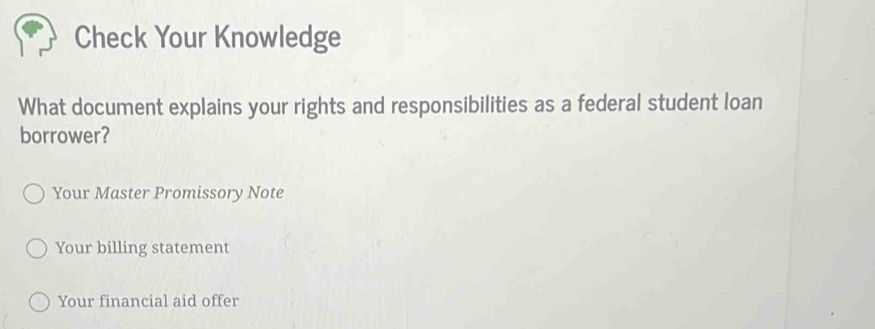
What document explains your rights and responsibilities as a federal student loan borrower?
A. Your Master Promissory Note
B. Your billing statement
C. Your financial aid offer
The correct answer is A. Your Master Promissory Note. The Master Promissory Note explains the borrower’s legal promise to repay a federal student loan, along with key rights and responsibilities. That is why it is the right answer to “what document explains your rights and responsibilities as a federal student loan borrower?”
Why Your Master Promissory Note is the correct answer
Your Master Promissory Note, often called an MPN, is the legal document you sign when taking out a federal student loan. It says that you agree to repay the loan and follow the loan terms. It also explains important borrower information, such as repayment obligations, interest, deferment, forbearance, and what may happen if the loan is not repaid.
The key word in the question is “rights and responsibilities.” A billing statement may show what you owe right now, but it does not explain the full legal agreement. A financial aid offer may show what aid a school offers you, but it is not the document that creates the repayment promise. The MPN is different because it connects the loan, the borrower, and the repayment rules in one formal agreement.
A simple way to understand it: the Master Promissory Note is like signing a promise with instructions attached. It does not only say “you borrowed money.” It also tells you what you must do and what options may exist while repaying the loan.
Why the other answer choices are not correct
Your billing statement is not the correct answer because it mainly shows payment information. It may include the amount due, due date, account balance, or recent activity. That helps you manage payments, but it does not fully explain your federal student loan rights and responsibilities as the original loan agreement does.
Your financial aid offer is also not correct. A financial aid offer, sometimes called an award letter, tells you what types of aid a school may provide. It can include grants, scholarships, work-study, and loans. It helps you decide what aid to accept, but it is not the same as signing the legal loan document.
The easiest wrong choice to confuse with the correct answer is the financial aid offer. It appears before or around the time you accept student aid, so it feels official. The difference is simple: the financial aid offer lists possible aid, while the Master Promissory Note explains the legal promise and loan responsibilities after borrowing.
Helpful context about federal student loan documents
Federal student loan documents serve different jobs, so the names matter. The financial aid offer helps you compare aid. The Master Promissory Note records your promise to repay. The billing statement helps you track payments after repayment begins. Mixing these up can lead to the wrong answer in a quiz because all three are connected to student loans, but only one explains the borrower’s rights and responsibilities.
For a federal student loan borrower, the Master Promissory Note is especially important because it is tied to the loan’s terms. It is not a casual notice or school estimate. It is the document that sets out the repayment promise and explains the rules that apply to the borrower.
Quick way to remember this type of question
Remember the word “promissory.” It comes from “promise.” If a question asks which document explains your promise to repay, your rights, and your responsibilities, choose Your Master Promissory Note.
Use this shortcut: offer means possible aid, bill means current payment, promissory note means legal promise. So when the question asks “what document explains your rights and responsibilities as a federal student loan borrower?”, the answer is the Master Promissory Note.
