
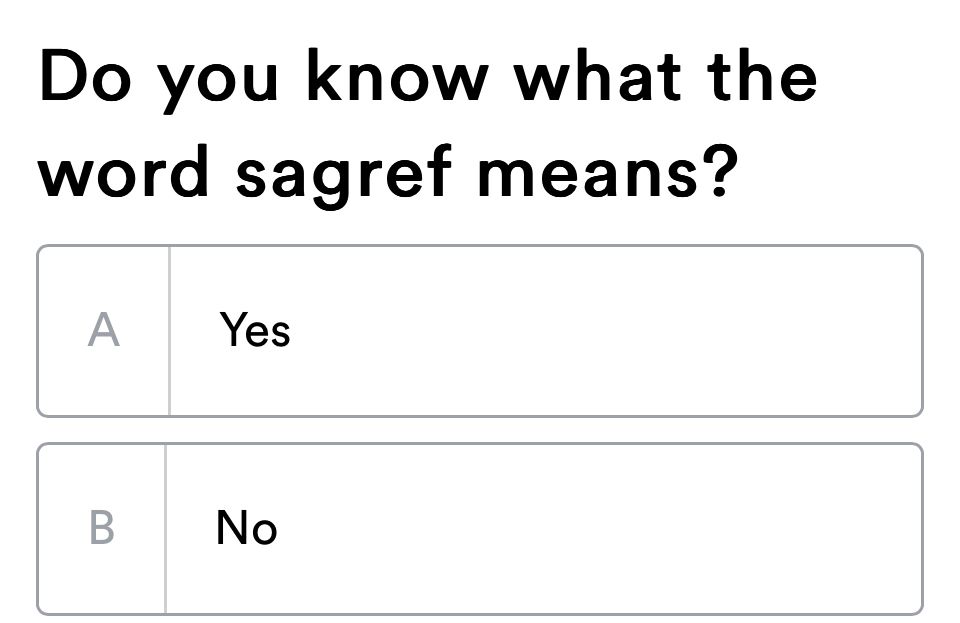
Do you know what the word sagref means? A) Yes B) No
The correct answer is B. No. The word “sagref” has no recognized meaning in any standard dictionary — English or otherwise. It is not a real word, so the honest answer is simply “No, I don’t know what it means,” because there is nothing to know.
Why “No” Is the Only Honest Answer
The question is designed as a self-check, not a vocabulary test. It does not ask you to define sagref; it simply asks whether you know the definition. Since the word does not exist in English dictionaries, linguistic databases, or any widely documented language, no one genuinely knows what it means. Answering “Yes” would be claiming knowledge of something that has no established meaning — which is, by definition, incorrect.
This style of question tests intellectual honesty more than raw knowledge. Admitting you do not know something is the accurate response when the thing itself has no real content to know. The trick lies in the expectation that many people will feel embarrassed to pick “No” or will assume the word must mean something they have forgotten.
Why Choosing “Yes” Is a Trap
Option A — “Yes” — is the answer most likely to tempt people, and that is exactly the point. Several psychological tendencies push a person toward selecting it. First, there is the assumption that any word presented in a quiz must be a real word the quiz-maker expects you to recognize. Second, “sagref” looks vaguely plausible: it could pass as a borrowed term from Latin, Old English, or another language. Some might even mentally connect fragments — “sag” or “ref” — to familiar roots and convince themselves they recall a meaning.
None of that changes the fact that sagref is not a documented word. Choosing “Yes” means claiming certainty you do not actually have, which makes it the wrong answer regardless of how confident the guess feels.
Where Questions Like This Come From
Trick questions built around fabricated words appear frequently in social-media quizzes, psychological surveys, and even standardized test research. Researchers studying the “overclaiming” bias — the tendency to claim familiarity with things that do not exist — use exactly this technique. A well-known example is the “overclaiming questionnaire,” where participants rate their knowledge of both real and fictitious items. People who say “Yes” to fake entries reveal a pattern of overestimating what they know.
The word sagref functions the same way. It is deliberately invented to look just credible enough that someone might bluff their way past it. Recognizing this pattern helps you pause before answering similar questions in the future.
Quick Tip for Spotting Trick Word Questions
Whenever a question asks “Do you know X?” rather than “What does X mean?”, treat it as a red flag. The first phrasing tests self-awareness; the second tests recall. If you cannot immediately and confidently define the term, the safest and most accurate answer is “No.” A genuine vocabulary question would ask you to choose a definition, not merely confirm whether you recognize the word. Apply this rule and you will avoid falling for fabricated terms like sagref every time.
