
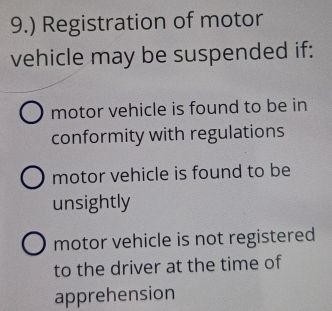
Here is the question: Registration of motor vehicle may be suspended if:
- A. Motor vehicle is found to be in conformity with regulations
- B. Motor vehicle is found to be unsightly
- C. Motor vehicle is not registered to the driver at the time of apprehension
The correct answer is C. Motor vehicle is not registered to the driver at the time of apprehension. When a driver is caught operating a vehicle that is not registered under their name, authorities have grounds to suspend that vehicle’s registration because the mismatch raises concerns about ownership, accountability, and potential violations of motor vehicle law.
Why This Answer Is Correct
Motor vehicle registration exists to link a specific vehicle to a specific owner. This linkage serves several purposes: it ensures the registered owner carries proper insurance, pays the correct taxes and fees, and can be held legally responsible for violations or accidents involving that vehicle. When a driver is apprehended and the vehicle they are operating is not registered in their name, that critical link between vehicle and accountable owner is broken.
Philippine traffic and transportation law — particularly provisions under Republic Act No. 4136 (the Land Transportation and Traffic Code) and related LTO regulations — empowers the Land Transportation Office to suspend or revoke a vehicle’s certificate of registration under certain conditions. One clear trigger is when the person driving the vehicle at the time of apprehension is not the registered owner and cannot produce authorization. This situation may indicate the vehicle was sold without proper transfer of registration, is being used without the owner’s consent, or is involved in some other irregularity. Suspension of registration in this scenario protects public safety by pulling a potentially improperly documented vehicle off the road until ownership and registration are clarified.
Why the Other Options Are Incorrect
Option A states the vehicle “is found to be in conformity with regulations.” This is the opposite of a reason to suspend registration. A vehicle that meets all regulatory requirements — proper emissions, safety features, up-to-date registration — is exactly the kind of vehicle authorities want on the road. Conformity is a reason to maintain registration, not suspend it. This option tests whether you read carefully; some test-takers pick it by mistake if they rush through the question and miss the word “conformity.”
Option B claims the vehicle “is found to be unsightly.” While a vehicle in poor cosmetic condition might look neglected, appearance alone is not a legal basis for suspending registration. Traffic laws focus on roadworthiness — brakes, lights, tires, structural integrity — not on whether a car looks attractive. A vehicle can be dented, faded, or scratched and still be perfectly legal to drive, as long as it passes inspection standards. This option is the least tempting distractor because most people intuitively understand that “ugly” is not illegal.
The most common mistake is choosing Option A, especially for test-takers who confuse “conformity” with “non-conformity.” Read the option twice: it says the vehicle is in conformity, meaning it follows the rules. That is a good thing, not a reason for suspension.
Key Context: When Else Can Registration Be Suspended?
Beyond the scenario in this question, registration of a motor vehicle can also be suspended or revoked for other reasons under Philippine law. These include failure to pay registration fees on time, involvement of the vehicle in a hit-and-run incident, using a vehicle for purposes not covered by its registration classification (such as using a private vehicle for public transport without a franchise), or when the vehicle is found to have tampered chassis or engine numbers. Understanding this broader context helps you see a pattern: suspension of registration is always tied to a legal or regulatory violation — never to cosmetic issues or to the vehicle actually meeting standards.
Quick Tips to Remember This Type of Question
Focus on the word “suspended.” Suspension is a penalty or precaution, so the correct trigger must describe something wrong or irregular. Eliminate any option that describes a normal, positive, or legally compliant situation — like Option A. Next, eliminate options that mention factors irrelevant to traffic law — like physical appearance in Option B. What remains should involve a concrete legal issue, such as a registration-ownership mismatch. Whenever a question asks about grounds for suspension or revocation, look for the option that points to a violation of the registration system itself: wrong name, expired documents, unauthorized use, or missing paperwork.
