
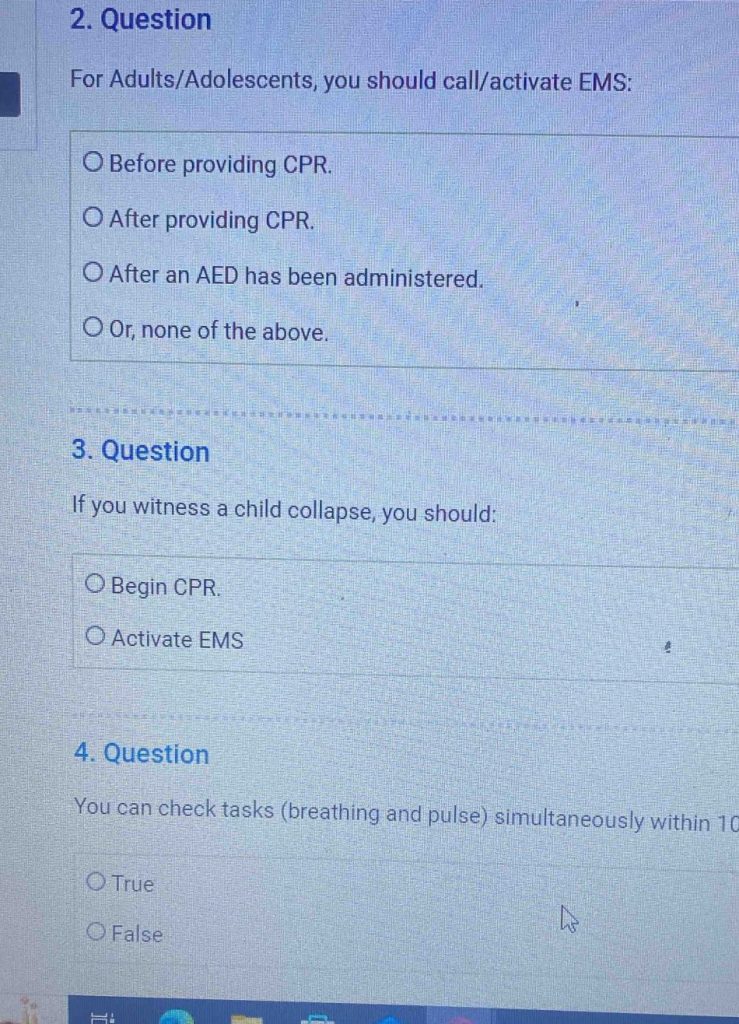
Question 2: For Adults/Adolescents, you should call/activate EMS: A) Before providing CPR. B) After providing CPR. C) After an AED has been administered. D) Or, none of the above.
Question 3: If you witness a child collapse, you should: A) Begin CPR. B) Activate EMS.
Question 4: You can check tasks (breathing and pulse) simultaneously within 10 seconds. A) True. B) False.
The correct answers are: Question 2 — A) Before providing CPR; Question 3 — B) Activate EMS; Question 4 — B) False. For adults and adolescents, current resuscitation guidelines prioritize calling for help first because the most common cause of cardiac arrest in this age group is a heart rhythm problem that requires defibrillation, not a breathing issue that CPR alone can fix. Getting EMS and an AED on the way as fast as possible gives the victim the best chance of survival.
Why You Activate EMS Before CPR for Adults and Adolescents
Adult and adolescent cardiac arrests are overwhelmingly caused by sudden cardiac events — typically ventricular fibrillation or ventricular tachycardia. These abnormal heart rhythms cannot be corrected by chest compressions alone. They require an electric shock from an AED (automated external defibrillator). Every minute without defibrillation reduces the chance of survival by roughly 7–10%. By calling 911 or your local emergency number immediately, you set two critical things in motion at once: paramedics begin traveling to the scene, and a dispatcher can guide you through CPR over the phone while help is on the way.
The American Heart Association (AHA) and the American Red Cross both teach the same sequence for an unresponsive adult: check the scene for safety, check responsiveness, call/activate EMS (or send someone to call), then begin CPR. This “call first” protocol exists specifically because early defibrillation — not CPR by itself — is the intervention most likely to restart the heart in adults.
Why the Other Options Are Wrong
B) After providing CPR — this is the protocol for children and infants when you are the only rescuer and did not witness the collapse. Pediatric cardiac arrests are more often caused by respiratory failure (choking, drowning, asthma), so giving about 2 minutes of CPR first can address the underlying oxygen problem before you leave to call for help. Applying this rule to adults reverses the priority and delays the defibrillator that an adult victim desperately needs. This is the most commonly confused option because test-takers mix up the adult and pediatric sequences.
C) After an AED has been administered — waiting until after an AED shock to call EMS would waste precious minutes. You may not even have an AED nearby. EMS should already be en route long before an AED is located and applied.
D) None of the above — option A is clearly supported by current guidelines, so “none of the above” does not apply.
Quick Breakdown of Questions 3 and 4
Question 3 — Witnessed child collapse → Activate EMS. When you actually see a child collapse, the cause is more likely cardiac (similar to an adult scenario) rather than a slow respiratory decline. That witnessed collapse changes the protocol: treat it like an adult case and call for help immediately so a defibrillator arrives as soon as possible. If the collapse were unwitnessed, you would give 2 minutes of CPR first, then call — because an unwitnessed pediatric arrest is more likely respiratory in origin.
Question 4 — Checking breathing and pulse simultaneously within 10 seconds → False. While rescuers are taught to assess breathing and pulse at the same time to save time, the critical detail is the word “tasks.” In BLS training, checking breathing and checking a pulse are two separate assessments that happen to be performed during the same 10-second window, but they are not described as interchangeable “tasks” you simply combine. The statement as worded is considered false in the context of this course material, because the phrasing implies the two checks are a single merged action rather than distinct evaluations performed concurrently within a strict time limit.
Why the Adult vs. Child Distinction Matters So Much
The difference between “call first” and “CPR first” comes down to the most probable cause of arrest. Adults develop cardiac arrest primarily from heart disease — a blocked coronary artery triggers a fatal arrhythmia. The fix is electrical (defibrillation), so getting the AED there fast is everything. Children, on the other hand, usually arrest because they stop breathing adequately first; the heart stops second. Providing ventilations and compressions for about 2 minutes can push enough oxygen into the bloodstream to buy time. Memorizing this cause-and-effect chain makes the protocol easy to recall without rote memorization.
One important exception blurs this line: a witnessed pediatric collapse. Because you saw the child drop suddenly — suggesting a cardiac cause like a congenital arrhythmia — you follow the adult “call first” rule. This exception appears frequently on certification exams and is exactly what Question 3 tests.
Memory Tips for Similar Questions
Use the phrase “Adult = Call First, Child alone = CPR First.” Picture an adult holding a phone (calling EMS) and a child receiving chest compressions. The single exception to remember: if you witness a child collapse, treat it like an adult scenario — call first. For the 10-second check, remember the number 10 as a hard ceiling, not a target: if you cannot definitively feel a pulse within 10 seconds, start CPR. Hesitation kills. On any BLS or CPR exam, whenever a question asks about activating EMS for adults or adolescents, the answer almost always points to doing it before hands-on interventions begin.
