
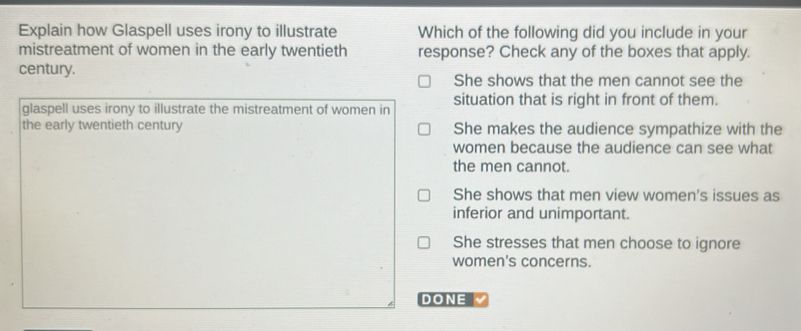
Question: Explain how Glaspell uses irony to illustrate mistreatment of women in the early twentieth century. Which of the following did you include in your response? Check any of the boxes that apply.
- She shows that the men cannot see the situation that is right in front of them.
- She makes the audience sympathize with the women because the audience can see what the men cannot.
- She shows that men view women’s issues as inferior and unimportant.
- She stresses that men choose to ignore women’s concerns.
The correct answer is: all four statements should be checked. Each one identifies a distinct layer of dramatic irony that Susan Glaspell builds into her one-act play Trifles (1916) to expose how women were dismissed and mistreated in the early twentieth century. The men literally mock the domestic details that turn out to hold the key evidence, and the audience watches this blindness unfold in real time.
Why All Four Statements Are Correct
Glaspell’s irony operates on multiple levels simultaneously, and each checklist item captures one of those levels. In Trifles, the County Attorney and the Sheriff enter Minnie Wright’s farmhouse looking for a motive for murder. They search the barn, the bedroom, and the outbuildings — everywhere except the kitchen, which they dismiss as the domain of mere “trifles.” Meanwhile, Mrs. Hale and Mrs. Peters, confined to that very kitchen by the men’s condescension, discover the strangled canary, the erratic quilt stitching, and the broken birdcage — evidence that directly reveals Minnie’s motive and emotional state.
This setup fulfills every item on the checklist. The men cannot see what is right in front of them because they have already decided that nothing in a woman’s workspace matters. The audience, however, watches the women piece together the truth, creating sympathy for the female characters and frustration with the male ones. Glaspell makes it unmistakable that the men view women’s domestic concerns as inferior: the Sheriff laughs at the idea of worrying about preserves, and the Attorney calls the kitchen “nothing but kitchen things.” Finally, the men do not merely fail to notice — they actively choose to ignore every hint the women try to share, reinforcing the pattern of willful dismissal rather than simple oversight.
How Each Layer of Irony Works in the Play
The men cannot see the situation in front of them. This is situational irony at its most pointed. The professional investigators pride themselves on rationality, yet they overlook the most important room in the house. Glaspell reverses the expected competence hierarchy: the “untrained” housewives solve the case while the lawmen leave empty-handed.
The audience sympathizes with the women. Because Trifles is a play performed before a live audience, dramatic irony is especially powerful. Spectators see Mrs. Peters discover the dead canary and watch her face change. They know the motive before any male character does. That gap in knowledge forces the audience to feel what the women feel — the frustration of being ignored by people who hold authority over you.
Men view women’s issues as inferior. The title itself is ironic. “Trifles” is the word the men use to belittle domestic work, yet those trifles contain the entire solution. Glaspell chose the title deliberately: every time a reader or viewer encounters it, the irony reinforces the theme of gendered dismissal.
Men choose to ignore women’s concerns. There is a subtle but important difference between not seeing and choosing not to look. When Mrs. Hale mentions the quilt, the Sheriff responds with open ridicule. He has the opportunity to investigate but refuses. Glaspell stresses that the mistreatment is not accidental ignorance — it is a social norm that men actively uphold.
Why Some Students Check Only One or Two Boxes
The most common mistake is selecting only the first statement — that the men cannot see the situation — and treating it as the single “best” answer. This happens because students recognize situational irony quickly but overlook dramatic irony (the audience’s perspective) and thematic irony (the social commentary). The question, however, says “check any that apply,” signaling that multiple answers are expected. All four statements describe different but equally valid dimensions of Glaspell’s ironic technique. Skipping the statement about audience sympathy is another frequent error; students sometimes forget that a play is designed to be watched, and the audience’s awareness is a deliberate storytelling tool, not a side effect.
The Broader Context: Glaspell and Early Twentieth-Century Feminism
Susan Glaspell based Trifles on a real 1900 murder case she covered as a journalist in Iowa. A farmer named John Hossack was killed with an axe, and his wife Margaret was charged. Glaspell observed how the legal system — run entirely by men — struggled to understand the domestic dynamics that may have driven the crime. She transformed that observation into a play where the structure itself becomes an argument: by letting the women solve the mystery through kitchen evidence while the men fail, Glaspell does not merely tell the audience that women are underestimated — she shows it happening in real time. This method of using dramatic form to deliver social critique influenced American feminist theater for decades afterward.
Quick Tip for Similar Questions
When a literature question asks “which did you include — check all that apply,” treat each option independently. Ask yourself: “Does the text support this specific claim?” If yes, check it, even if it overlaps with another option. Glaspell questions on standardized assignments almost always test whether students can distinguish between types of irony — situational (what happens vs. what is expected), dramatic (audience knows more than characters), and thematic (the title or premise contradicts the deeper meaning). Labeling each type in the margin of the text before answering saves time and prevents missed checkboxes.
