
x*x*x Is Equal to 2 – What Is x?
The problem asks: if x · x · x = 2, what is the value of x? Written in exponential form, this is x³ = 2.
The correct answer is x = ∛2 (the cube root of 2), which equals approximately 1.2599. Because ∛2 multiplied by itself three times gives exactly 2, this is the only real number that satisfies the equation.
Why x = ∛2 Is the Correct Solution
When we write x*x*x is equal to 2, we are really writing x³ = 2. Solving for x means finding the number whose third power equals 2. The inverse operation of cubing is taking the cube root, so x = 2^(1/3), commonly written as ∛2.
A quick verification confirms this. Compute (∛2)³: by definition, raising a cube root to the third power cancels the root, returning the original number — 2. Numerically, 1.2599 × 1.2599 × 1.2599 ≈ 2.0000. The algebra and the arithmetic agree.
∛2 is an irrational number. It cannot be expressed as a simple fraction, and its decimal expansion (1.25992104989…) never terminates or repeats. This is proven the same way one proves √2 is irrational — by assuming a rational form p/q in lowest terms and reaching a contradiction. So when someone asks for the “exact” answer to x·x·x = 2, the proper response is the symbolic form ∛2, not a rounded decimal.
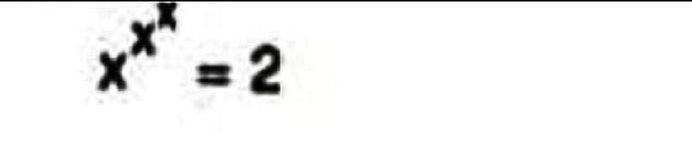
A Common Confusion: x^(x^x) = 2 vs. x³ = 2
The original source pairs the equation with an image showing x^(x^x) = 2 and claims the answer is x = √2. These are two entirely different problems, and mixing them up is the easiest mistake to make here.
x³ = 2 (which is what x*x*x = 2 means) has the straightforward solution x = ∛2 ≈ 1.2599. No ambiguity exists.
x^(x^x) = 2 is a tower-exponentiation equation. If we test x = √2 ≈ 1.4142, we get √2 raised to the power (√2)^(√2). Evaluating the inner exponent: (√2)^(√2) = 2^(1/2 · √2) = 2^(√2/2) ≈ 2^0.7071 ≈ 1.6325. Then (√2)^1.6325 = 2^(1.6325/2) = 2^0.8163 ≈ 1.757, which is not 2. So x = √2 does not even solve the tower equation exactly in general — it only works under a specific interpretation where the tower is evaluated as (x^x)^x = x^(x·x) = x^(x²), which for √2 gives (√2)^2 = 2. That interpretation relies on left-to-right grouping rather than the standard right-to-left convention for power towers.
The key takeaway: the expression “x*x*x” unambiguously means x multiplied by itself three times — x³ — and its solution when equal to 2 is ∛2, not √2.
Why Other Values Fail
x = √2 (≈ 1.4142): This is the most tempting wrong answer because it appears in many versions of this problem online. But (√2)³ = 2^(3/2) = 2√2 ≈ 2.828, which is clearly not 2. The square root of 2 solves x² = 2, not x³ = 2.
x = 1: 1³ = 1, not 2. Any power of 1 is always 1, so this never works unless the target is 1.
x = 2: 2³ = 8, far too large. This answer confuses the base with the result.
Negative cube root: Unlike square roots, cube roots of positive numbers have only one real value, which is positive. The equation x³ = 2 has exactly one real solution: ∛2. (There are two complex solutions, but those are outside the scope of typical exam questions on this topic.)
Broader Context: Cube Roots and nth Roots
The cube root belongs to the family of nth roots. Just as a square root undoes squaring, a cube root undoes cubing, a fourth root undoes raising to the fourth power, and so on. The general rule is: if xⁿ = a, then x = a^(1/n), provided we restrict ourselves to real, positive solutions when a is positive.
Cube roots have a special property that square roots do not: every real number — positive, negative, or zero — has exactly one real cube root. So x³ = −8 gives x = −2 with no issues, whereas x² = −4 has no real solution at all. This distinction matters in algebra and shows up frequently in standardized tests. When you see x*x*x equal to any real number, you can always find exactly one real answer by taking the cube root.
Quick Tips to Remember
Matching the right root to the right power prevents most errors. A simple mnemonic: the exponent tells you which root to take. x² = 2 → square root. x³ = 2 → cube root. x⁴ = 2 → fourth root. The number of x’s multiplied together equals the index of the root.
If you ever doubt your answer, plug it back in. Cube your candidate and see if you get 2. This ten-second check catches mistakes that algebraic manipulation sometimes hides — especially when exponent towers or nested powers are involved. For x*x*x is equal to 2, the answer ∛2 passes this test; √2 does not.
