
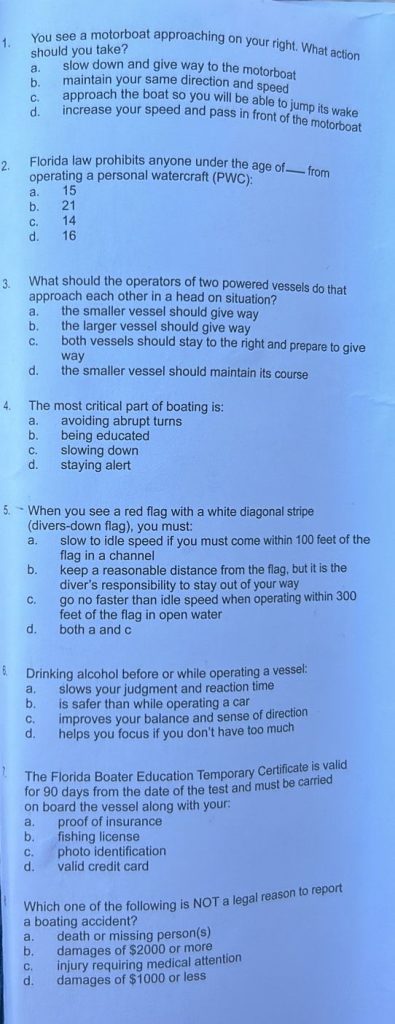
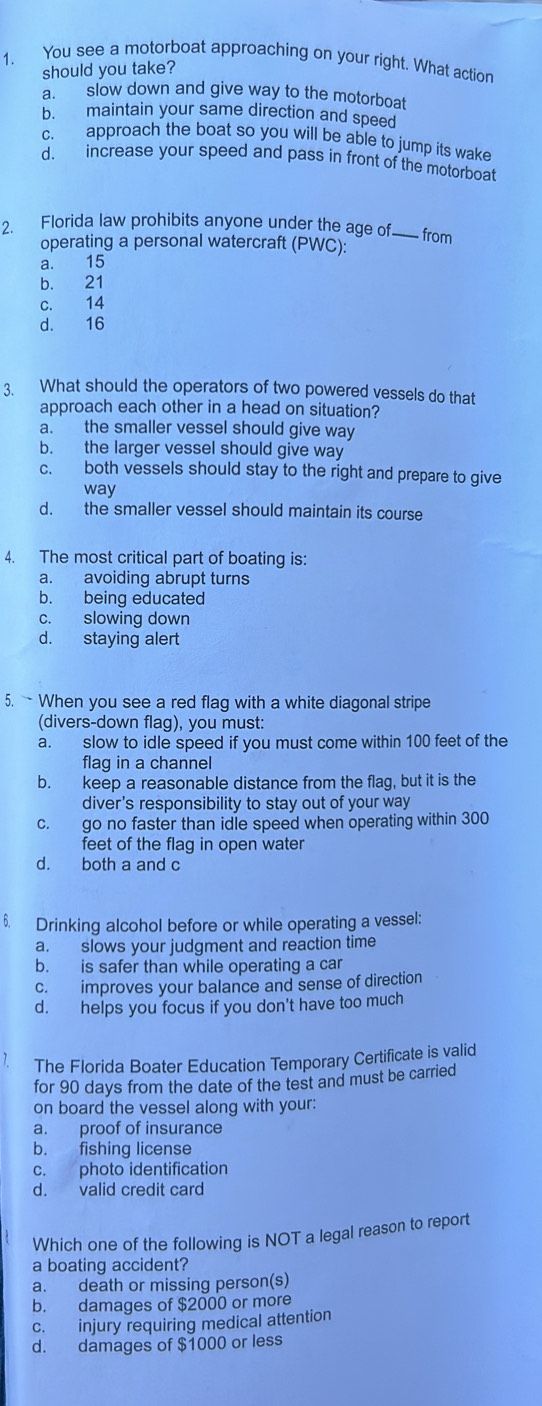
You see a motorboat approaching on your right. What action should you take? a. slow down and give way to the motorboat b. maintain your same direction and speed c. approach the boat so you will be able to jump its wake d. increase your speed and pass in front of the motorboat
The correct answer is A. slow down and give way to the motorboat. When a powered vessel approaches from your starboard (right) side, you are the give-way vessel and must yield. This is the core rule that answers you see a motorboat approaching on your right. what action should you take? and it prevents crossing collisions.
Why Slowing Down and Giving Way Is the Correct Action
The rule is correct because navigation rules designate a stand-on vessel and a give-way vessel in a crossing situation. The vessel approaching from the right has the right of way.
Under the U.S. Coast Guard Navigation Rules (COLREGs) and Florida boating regulations, which follow the same principle, when two power-driven vessels are crossing, the vessel which has the other on its starboard side must keep out of the way. If you see a motorboat on your right, that boat is the stand-on vessel — it should maintain course and speed. You are the give-way vessel — you must take early and substantial action to stay clear, which normally means slowing down, altering course to starboard and passing behind its stern.
The logic is simple and practical for a 5th-grade level: imagine an intersection without traffic lights. The vehicle on the right goes first. On water, there are no lanes or brakes like on roads, so giving way early avoids a collision that both boats might not be able to stop quickly. Slowing down reduces wake, gives you more time to judge distance, and shows the other operator your intention clearly.
Why the Other Options Are Incorrect
Each of the other choices violates the crossing rule or creates danger.
Option B. maintain your same direction and speed is what the stand-on vessel does, not the give-way vessel. If you are the boat with the other vessel on your right, maintaining course would force the stand-on vessel to maneuver to avoid you, which reverses the roles and increases collision risk. This is the most common confusion: students remember that one boat should hold course, but forget that it only applies to the vessel that is being approached from its left.
Option C. approach the boat so you will be able to jump its wake is both illegal and dangerous. Intentionally crossing close to jump a wake can cause loss of control, ejection from the vessel, and injury to passengers. Florida law requires responsible operation, and safe boating courses specifically warn against wake jumping, especially near other vessels.
Option D. increase your speed and pass in front of the motorboat is the most dangerous choice. Accelerating to cross ahead of the stand-on vessel assumes you can outrun the other boat, but you misjudge its speed and distance. This creates a classic T-bone collision scenario where neither vessel has time to stop.
Additional Florida Boating Rules From the Same Test
The original quiz includes seven other Florida-specific rules that often appear together, so understanding them helps you pass the full exam.
1. Age for PWC operation: Florida law prohibits anyone under age 14 from operating a personal watercraft (PWC). This is stricter than for general motorboats.
2. Head-on situation between two powered vessels: Both vessels should stay to the right (starboard) and prepare to give way, passing port-to-port. Neither vessel has automatic right of way; both must act.
3. Most critical part of boating: Staying alert is considered the most critical part, more than just avoiding turns or slowing down, because awareness prevents most accidents.
4. Divers-down flag: A red flag with a white diagonal stripe means divers are below. You must operate at idle speed if you must come within 100 feet of the flag in a channel, and within 300 feet in open water. The correct answer is both distances apply (both a and c).
5. Alcohol and boating: Drinking before or while operating a vessel slows judgment and reaction time, just as with driving a car. Alcohol impairs balance, vision and decision-making, and is a leading factor in boating fatalities.
6. Florida Boater Education Temporary Certificate: Valid for 90 days from the date of the test and must be carried on board with your photo identification.
7. Reporting a boating accident: You must report death or disappearance, injury requiring medical attention, or damage of $2,000 or more. Damage of $1,000 or less is NOT a legal threshold for mandatory reporting.
How to Remember Give-Way Rules Quickly
Remember the phrase: Red on right, give way at night, but green on right means you hold tight is too complex. A simpler tip for crossing is Right is Right — the boat on your right has the right of way.
To distinguish crossing from head-on: if you see the other boat’s red sidelight (port side) at night, you are giving way. If you see both sidelights, it is head-on and both turn right. For Florida tests, also memorize numbers as pairs: PWC age 14, accident report $2,000, diver flag 100 feet in channel / 300 feet open water, certificate 90 days with photo ID. Linking them as 14-2000-100/300-90 helps recall under exam pressure.
