
What Does a Head Frame Do? Mine Shaft Hoisting Questions Answered
Here are the questions commonly asked about mine headframes and related hoisting equipment:
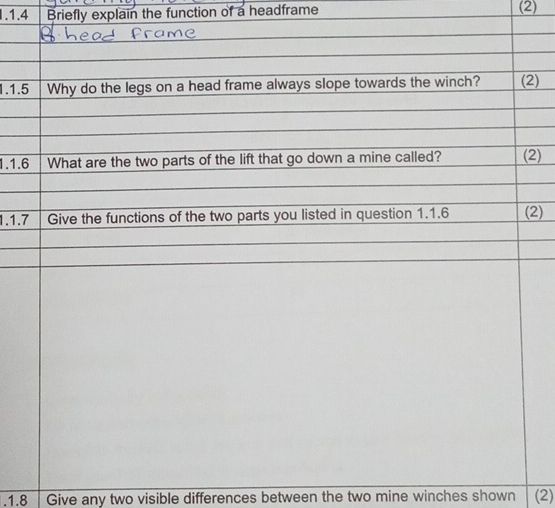
1.1.4 Briefly explain the function of a headframe.
1.1.5 Why do the legs on a head frame always slope towards the winch?
1.1.6 What are the two parts of the lift that go down a mine called?
1.1.7 Give the functions of the two parts you listed in question 1.1.6.
1.1.8 Give any two visible differences between the two mine winches shown.
The correct answer to “what does a head frame do” is: a headframe supports and houses the hoisting equipment used to raise and lower people and materials through a mine shaft. It acts as the structural tower built directly over the shaft opening, carrying the sheave wheels (pulleys) that guide the hoist ropes down into the earth. Without a headframe, there would be no way to suspend the cables and conveyances that make vertical mine access possible.
Why a Headframe Is Essential to Every Mine Shaft
A headframe — sometimes called a gallows frame, pit head frame, or winding tower — serves one core purpose: it provides the elevated structure needed to hang hoisting ropes vertically above the shaft. The sheave wheels mounted at the top of the frame redirect the rope from the winch drum, which sits on the surface some distance away, straight down into the shaft. This vertical drop is critical because the cage or skip must travel in a perfectly plumb line to avoid scraping the shaft walls or jamming in the guides.
Beyond simply holding pulleys, the headframe also absorbs the dynamic loads created every time a loaded skip accelerates upward or brakes to a stop. A typical gold or coal mine skip can weigh several tonnes when full, so the frame must be engineered to handle repeated stress cycles over decades. Steel lattice headframes are common in modern operations, though concrete and timber versions exist depending on shaft depth and load requirements.
Answers to the Remaining Questions (1.1.5 – 1.1.8)
1.1.5 — Why do the legs slope towards the winch?
The legs of a head frame angle inward toward the winch to counteract the horizontal pull exerted by the hoist rope. When the rope runs from the sheave wheel down to the winch drum, it creates a diagonal force that tries to topple the frame in that direction. By sloping the legs toward the winch, the structure’s centre of gravity shifts to resist that pull, keeping the entire frame stable under load. Think of it like leaning into a strong wind — you tilt toward the force so you do not fall away from it.
1.1.6 — The two parts of the lift
The two conveyances that travel up and down a mine shaft are the cage and the skip. They are both suspended from hoist ropes guided by the headframe, but they serve entirely different roles underground.
1.1.7 — Functions of the cage and skip
The cage transports miners and other personnel between the surface and the working levels. It is essentially a mine elevator, fitted with safety catches that grip the guide rails if the rope fails. The skip, on the other hand, carries ore, rock, or waste material to the surface. Skips are open-topped or have a tipping mechanism so they can be emptied quickly into surface bins. In many operations the cage and skip run in separate shaft compartments to avoid interference, though some smaller mines alternate their use in a single compartment.
1.1.8 — Two visible differences between mine winches
When comparing two mine winches side by side, observable differences commonly include:
- Drum size and configuration — one winch may use a single drum while the other uses a double drum, or the diameters may differ noticeably, reflecting different rope lengths and load capacities.
- Brake system design — disc brakes versus caliper brakes, or post brakes mounted externally, will look distinctly different in size, position, and housing.
Other visible contrasts can include the motor housing shape (indicating AC versus DC drive), the presence of rope-depth indicators, or the overall footprint of the winch bed. The key word in the question is “visible,” so answers must describe something you can see, not a performance specification hidden in a datasheet.
How the Headframe, Winch, Cage, and Skip Work Together
Understanding what a head frame does becomes clearer when you see the full system. The winch, located on the surface some distance from the shaft, winds or unwinds the steel rope. That rope travels along the ground to the base of the headframe, then runs up and over the sheave wheel at the top, before dropping vertically down the shaft to the cage or skip. When the winch drum turns one way, the conveyance rises; reverse the drum and it descends.
Because the rope approaches the sheave wheel at an angle (not vertically), the headframe must resist a constant sideways tug — which is exactly why those legs slope toward the winch. Meanwhile, the shaft itself is divided into compartments: one for the cage, one for the skip, and often a third for pipes, cables, and a ladder way used in emergencies. Guide rails inside each compartment keep the cage and skip from swinging, and safety dogs on the cage can lock onto those rails within milliseconds if the rope tension drops unexpectedly.
Quick Memory Tips for Mine Hoisting Questions
Frame → Up top. Whenever a question asks about the headframe, think “the tall structure standing over the hole.” Its job is always about supporting the pulley system above the shaft.
Cage = Carry people, Skip = Ship rock. The alliteration helps: Cage–Carry, Skip–Ship. If an exam question asks which part transports miners, the answer is always the cage.
Legs lean toward the load. The headframe legs slope toward the winch because force pulls in that direction. Picture a tug-of-war player leaning toward the opposing team — same principle.
“Visible” means eyes only. When a question specifies visible differences, restrict your answer to things you can physically see — drum size, brake type, frame colour, number of ropes — not hidden specs like horsepower or voltage rating.
