
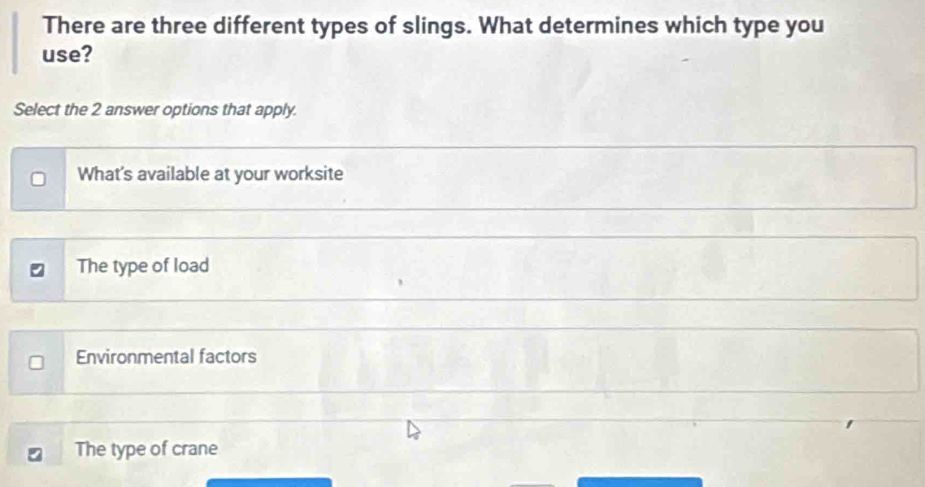
There are three different types of slings. What determines which type you use?
Select the 2 answer options that apply.
A. What’s available at your worksite
B. The type of load
C. Environmental factors
D. The type of crane
The correct answers are B. The type of load and C. Environmental factors. Sling selection depends on what must be lifted and the conditions around the lift. A load’s weight, shape, edges, and surface can change which sling is safe to use, while heat, chemicals, moisture, or sharp surroundings can affect sling strength and suitability.
Why the correct answers are the type of load and environmental factors
Sling selection starts with the load because the sling must safely support, grip, and protect what is being lifted. A heavy steel beam, a fragile machine part, and a bundle of pipes may need different sling materials or hitch methods. The load’s weight matters, but so do its shape, balance point, surface texture, and whether it has sharp edges that could cut or damage a sling.
Environmental factors also matter because a sling does not work in a vacuum. Heat can weaken some synthetic materials. Chemicals may damage certain sling fibers or metal parts. Wet, oily, or abrasive areas can change how securely the sling contacts the load. That is why the answer to “there are three different types of slings. what determines which type you use?” is not simply “pick one nearby.” The safe choice comes from matching the sling to the load and the work environment.
Why the other options are not the best answers
A. “What’s available at your worksite” is not a correct deciding factor because availability does not make equipment suitable. If only one sling is nearby but it is not rated for the load, damaged, or wrong for the conditions, it should not be used. Safety depends on suitability, not convenience.
D. “The type of crane” can affect the lifting setup, but it is not the main reason for choosing the sling type in this question. The crane lifts the load, while the sling connects to and supports the load. The sling must match the load and environment first.
The easiest wrong option to choose is A because it sounds practical. At a worksite, people may feel pressure to use what is close at hand. That is exactly the risk: using the available sling instead of the appropriate sling can lead to slipping, damage, or sling failure.
Quick way to remember this type of question
Use the simple rule: load first, surroundings second. Ask two quick questions before choosing a sling: “What am I lifting?” and “Where am I lifting it?” If the answer involves weight, shape, edges, balance, heat, chemicals, moisture, or abrasion, you are dealing with the two correct decision factors: the type of load and environmental factors.
Do not choose an answer only because it sounds convenient or equipment-related. For sling questions, the safest answer usually focuses on whether the sling fits the job, not whether it is nearby or attached to a certain machine.
