
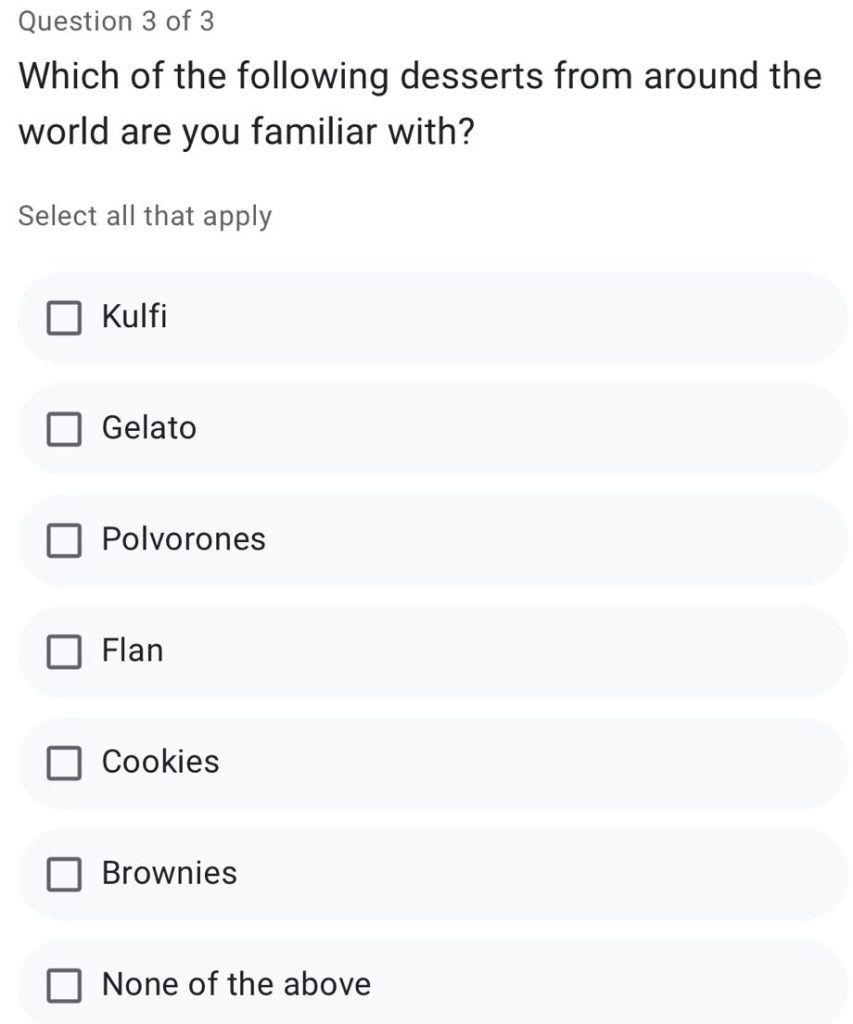
Which of the following desserts from around the world are you familiar with? Select all that apply:
- Kulfi
- Gelato
- Polvorones
- Flan
- Cookies
- Brownies
- None of the above
The correct answer includes all six desserts: Kulfi, Gelato, Polvorones, Flan, Cookies, and Brownies. Every option listed — except “None of the above” — is a genuine, well-known dessert originating from a distinct culinary tradition. This is not a trick question with one right choice; it is a familiarity poll, and each item names a real sweet treat enjoyed in different parts of the world.
Why All Six Options Are Legitimate Desserts
Each dessert on this list has a clear origin, distinct preparation method, and widespread recognition — which is exactly why the question asks you to “select all that apply” rather than pick just one. Here is what makes each one authentic.
Kulfi is a frozen dairy dessert from the Indian subcontinent, dating back to the Mughal era around the 16th century. Unlike Western ice cream, kulfi is not whipped during freezing, so it has a denser, creamier texture. Traditional flavors include cardamom, pistachio, mango, and saffron. It is typically set in small conical molds and remains popular across India, Pakistan, and Bangladesh.
Gelato originated in Italy and differs from standard ice cream in important ways: it contains less butterfat (usually 6–9% compared to ice cream’s 14–25%), is churned at a slower speed that incorporates less air, and is served at a slightly warmer temperature. The result is a smoother, more intensely flavored dessert. Gelato has been part of Italian culinary culture since at least the Renaissance period.
Polvorones are crumbly shortbread-style cookies with roots in Spain, particularly Andalusia. The name comes from polvo, the Spanish word for “dust,” because these treats practically dissolve into powdery crumbs when bitten. Made with flour, sugar, lard or butter, and often almonds or cinnamon, polvorones are a staple during Christmas celebrations in Spain, Mexico, the Philippines, and across Latin America.
Flan is a caramel custard dessert with a smooth, silky texture. Its origins trace to ancient Rome, but the version most people recognize today — baked custard topped with liquid caramel — became a signature dish in Spain and later spread throughout Latin America and the Philippines. French crème caramel is essentially the same dessert under a different name.
Cookies need little introduction. The modern cookie evolved from small test cakes Dutch bakers used to check oven temperatures; the word itself comes from the Dutch koekje, meaning “little cake.” Today cookies are baked and eaten worldwide in thousands of variations, from American chocolate chip to Middle Eastern ma’amoul.
Brownies are a dense, chocolate-baked dessert that emerged in the United States in the late 19th century. The earliest known printed recipe appeared in the 1897 Sears, Roebuck catalog. Brownies sit somewhere between a cake and a cookie in texture, and the ongoing “fudgy vs. cakey” debate is a defining feature of brownie culture.
When Would “None of the Above” Apply?
“None of the above” is only valid if a respondent has genuinely never encountered any of these six desserts — not even cookies or brownies, which are ubiquitous in most countries. For the vast majority of people, this option does not apply. It exists as a standard survey safeguard rather than as a likely correct selection.
The most common point of confusion in a question like this is assuming that an unfamiliar name means the item is not a real dessert. Someone who has never heard of polvorones or kulfi might hesitate to select them, mistaking the question for a test of whether each item is genuine. The question, however, asks about personal familiarity — not whether the dessert exists. All six are real, so the only consideration is which ones you personally recognize.
What These Desserts Reveal About Global Food Culture
This list is not random. It represents a cross-section of dessert traditions spanning at least five continents and several centuries. Kulfi and gelato both solve the same problem — how to create a frozen treat from milk — yet arrived at completely different textures because of different churning and freezing techniques. Polvorones and cookies share a shortbread-adjacent family tree but diverged into distinct identities shaped by local ingredients and customs. Flan and brownies, meanwhile, showcase two opposite approaches to eggs in baking: one uses eggs for a delicate custard set, the other for a dense, rich crumb.
Recognizing these connections helps build a broader understanding of how similar ingredients produce wildly different results depending on technique and cultural context. That awareness is useful well beyond a single quiz question.
Quick Tips for Similar “Select All That Apply” Questions
Read the prompt carefully. “Select all that apply” means more than one answer is expected — often most or all options are correct. Before dismissing an unfamiliar term, consider that the question may be testing breadth of knowledge rather than asking you to spot a fake. If every listed item sounds like it could be real, it probably is. When in doubt, recall: survey-style questions about familiarity have no wrong answers about the items themselves — they only measure what you know.
