
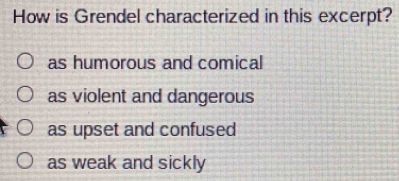
How is Grendel characterized in this excerpt?
- A. as humorous and comical
- B. as violent and dangerous
- C. as upset and confused
- D. as weak and sickly
The correct answer is B — as violent and dangerous. In the excerpt from Beowulf, Grendel is portrayed as a ferocious, bloodthirsty creature whose actions center on killing and terrorizing the warriors of Heorot. The language used to describe him emphasizes brute force, aggression, and an appetite for destruction — all hallmarks of a violent and dangerous character.
Why “Violent and Dangerous” Is the Correct Characterization
Grendel’s defining trait across every passage in Beowulf is relentless physical aggression. The Old English epic consistently pairs him with words related to slaughter, blood, and terror. When the poem describes Grendel entering Heorot at night, it details how he seizes sleeping warriors, tears them apart, and devours them. These are not the actions of a creature who is merely upset or confused — they are deliberate, predatory attacks carried out with overwhelming strength.
The poet also frames Grendel as a descendant of Cain, the biblical figure cursed for committing the first murder. This lineage is not accidental. It signals to the audience that Grendel carries an inherited capacity for violence that goes beyond ordinary hostility. He is dangerous precisely because his aggression has no negotiable limit: he cannot be reasoned with, bribed, or frightened away. For twelve years he raids Heorot unchallenged, which underscores just how threatening he is to an entire kingdom of armed warriors.
Why the Other Options Are Incorrect
A — “As humorous and comical” has no support in any known excerpt from Beowulf. The poem is an elegiac epic; its tone around Grendel is one of dread and sorrow, never comedy. Nothing about tearing warriors limb from limb is played for laughs. This option is the easiest to eliminate.
C — “As upset and confused” is the most tempting wrong answer. Some modern retellings — most notably John Gardner’s 1971 novel Grendel — do explore the monster’s inner emotional life, showing him as existentially confused and even sympathetic. However, the original Beowulf text does not grant Grendel that depth. In the excerpt, his motivation is portrayed as malice driven by his cursed nature, not emotional turmoil. Students who have studied the Gardner novel sometimes project those feelings onto the Old English poem, which is where the confusion arises.
D — “As weak and sickly” directly contradicts the text. Grendel overpowers dozens of trained warriors night after night. It takes Beowulf — a hero described as having the strength of thirty men in his grip — to finally defeat him. Weakness is the last quality the poet associates with this creature.
Grendel’s Role in the Larger Story of Beowulf
Understanding how Grendel is characterized in this excerpt becomes easier when you see what narrative purpose he serves. Beowulf follows a pattern common in heroic literature: the greater the villain’s threat, the greater the hero’s glory in overcoming it. By making Grendel extraordinarily violent and dangerous, the poet raises the stakes for Beowulf’s confrontation. If Grendel were weak, confused, or funny, Beowulf’s victory would mean very little.
Grendel also represents a specific cultural fear in Anglo-Saxon society — the outsider who attacks the communal hall, the symbol of civilization, fellowship, and safety. Heorot is where King Hrothgar’s warriors feast, sing, and strengthen social bonds. Grendel’s nightly assaults shatter that social order. His violence is not random; it targets the very heart of the community, which makes him dangerous on both a physical and a symbolic level.
Quick Tips for Characterization Questions
When a question asks how is a character characterized in a specific excerpt, focus on the verbs and adjectives the author actually uses in that passage — not on what you know from other versions or adaptations. Look for action words (seizes, devours, destroys) and descriptive language (grim, fierce, monstrous). Match those concrete textual clues to the answer choice that best reflects them. For Grendel in Beowulf, the language of blood, darkness, and killing maps directly onto “violent and dangerous,” and no other option comes close.
