
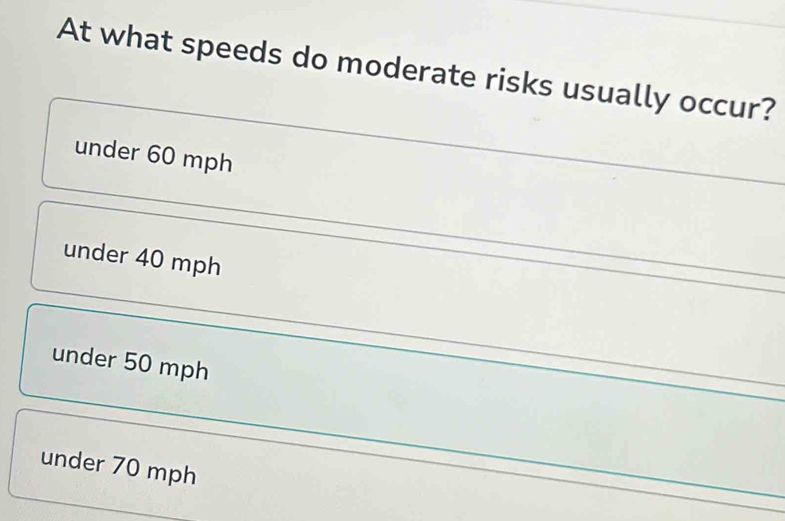
At what speeds do moderate risks usually occur? Here is the full question and all answer choices:
- A. Under 60 mph
- B. Under 40 mph
- C. Under 50 mph
- D. Under 70 mph
The correct answer is C. Under 50 mph. Moderate risks in driving and road safety contexts generally arise at speeds below 50 mph because this range is fast enough for collisions to cause significant injury and property damage, yet falls below the high-speed thresholds where risks escalate to severe or fatal categories.
Why Under 50 mph Is the Correct Threshold
Moderate risk refers to the level of danger where crashes can result in injuries that are serious but not typically life-threatening — broken bones, concussions, or significant vehicle damage. Traffic safety research consistently places this zone in the range of speeds below 50 mph, and here is the reasoning behind it.
At speeds under roughly 25–30 mph, the human body can usually absorb the forces of a collision with a much lower chance of fatal injury. As speed climbs toward the 40–50 mph range, kinetic energy increases dramatically. Kinetic energy follows the formula KE = ½mv², which means that doubling your speed quadruples the energy involved in a crash. A car traveling at 50 mph carries about 56% more kinetic energy than one traveling at 40 mph. That jump is what pushes the risk classification from low or minor into the moderate zone.
Once speeds exceed 50 mph and move toward 60, 70 mph or above, crash outcomes shift sharply toward severe and fatal injuries. Seatbelts, airbags, and crumple zones become less effective at absorbing energy at those higher speeds. This is why many urban and suburban speed limits are set at or below 50 mph — engineers design those limits around keeping crash outcomes within a survivable, moderate-risk window.
Why the Other Choices Are Incorrect
A. Under 60 mph covers a range that extends well into what safety frameworks classify as high risk. Crashes at 55–60 mph generate enough force to cause severe or fatal injuries, especially in pedestrian collisions or side-impact scenarios. Labeling everything below 60 mph as merely “moderate” would understate the real danger in the upper portion of that range.
B. Under 40 mph is the most tempting wrong answer because low-speed collisions can certainly still cause harm. However, the under-40-mph zone is more accurately associated with low to minor risk levels in most classification systems. Picking this option would set the moderate-risk ceiling too low and leave the 40–50 mph band unaccounted for — a band where crash severity clearly exceeds “minor.”
D. Under 70 mph is far too broad. Speeds approaching 70 mph are highway speeds in most regions, and collisions at that velocity frequently result in catastrophic outcomes. Grouping everything below 70 mph under “moderate risk” would collapse three distinct risk tiers — low, moderate, and high — into a single category, making the classification useless.
Among the wrong answers, option A (under 60 mph) tends to trap the most test-takers. It sounds reasonable because 60 mph still feels like a “normal” driving speed, but the question specifically targets the moderate tier, not the combined moderate-and-high tier.
How Speed and Risk Categories Connect in Road Safety
Traffic safety organizations typically divide crash risk into three broad tiers tied to impact speed. Below roughly 30 mph, outcomes lean toward minor injuries or fender-benders. Between about 30 and 50 mph, the moderate zone, injuries become more serious and medical treatment is usually required. Above 50 mph, the probability of severe trauma or death rises steeply with every additional mile per hour.
This tiered model matters beyond exams. It shapes real-world decisions: why school zones enforce 15–25 mph limits, why residential streets cap at 25–35 mph, and why highways with higher speed limits invest heavily in median barriers, rumble strips, and wider clear zones. Each design choice maps back to the relationship between speed and the expected severity of a crash.
Quick Tip to Remember the Answer
Think of the phrase “fifty is the middle.” Moderate means middle — not the mildest, not the most extreme. Under 50 mph sits right in the center of the four choices, and “moderate” literally means mid-level. When you see a question asking about moderate risks and speed, look for the middle-range option rather than the lowest or highest number. That mental shortcut aligns with both the vocabulary and the physics: 50 mph is where crash energy is high enough to be serious but not yet in the catastrophic zone above 50–60 mph.
