
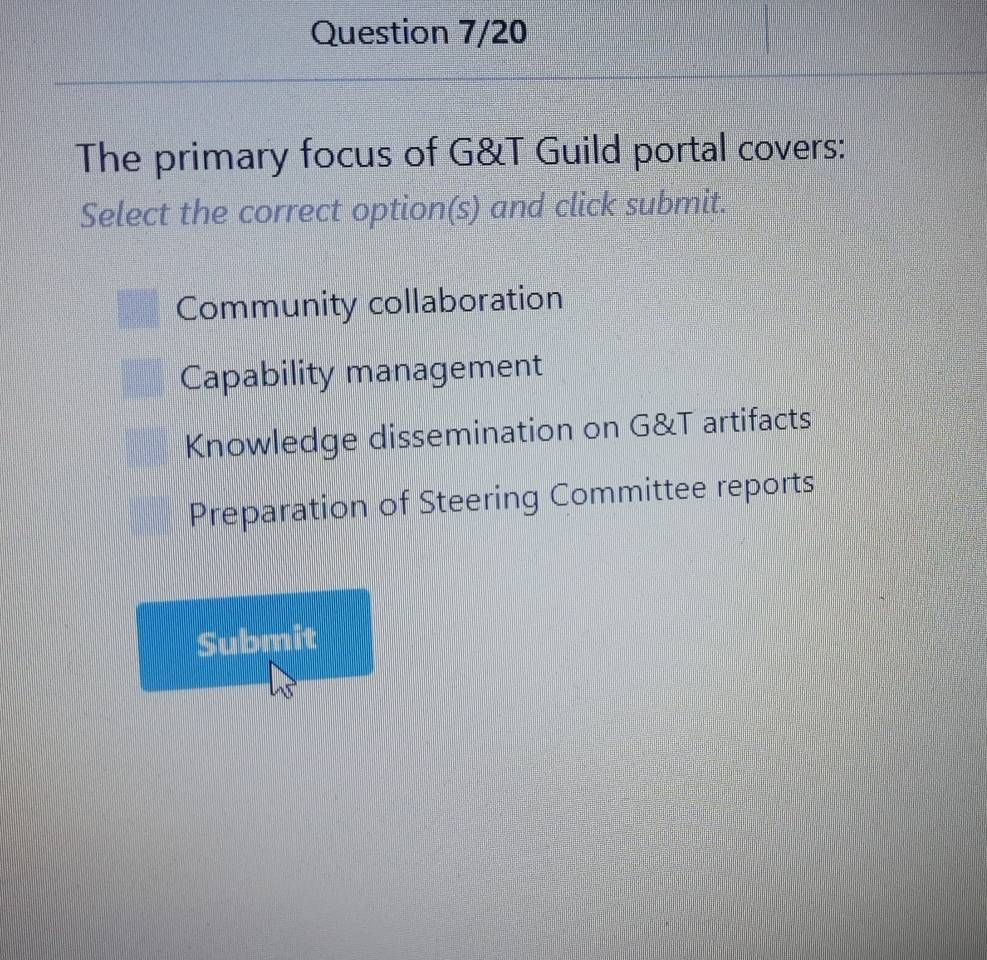
Question 7/20: The primary focus of G&T Guild portal covers:
A. Community collaboration
B. Capability management
C. Knowledge dissemination on G&T artifacts
D. Preparation of Steering Committee reports
The correct answers are A, B, and C — Community collaboration, Capability management, and Knowledge dissemination on G&T artifacts. These three functions represent the core purpose of the G&T Guild portal: building a collaborative community, managing and growing capabilities across teams, and sharing structured knowledge about G&T artifacts. Option D — Preparation of Steering Committee reports — falls outside the portal’s primary scope.
Why These Three Options Are Correct
The G&T Guild portal is designed as an internal platform that serves three interconnected purposes. Community collaboration means the portal acts as a shared space where practitioners across different teams can exchange ideas, raise questions, and align on best practices related to G&T work. It is not a static reference site — interaction among members is a defining feature.
Capability management refers to tracking, developing, and scaling the skills and competencies needed to deliver G&T services effectively. The portal helps leadership and team members identify skill gaps, plan training, and monitor progress — making capability growth systematic rather than ad hoc.
Knowledge dissemination on G&T artifacts addresses the need to document and distribute reusable frameworks, templates, methodologies, and lessons learned. Without a centralized channel for this, teams risk duplicating effort or applying outdated approaches. The portal solves that by serving as the single source of truth for G&T-related artifacts.
Together, these three pillars — collaborate, build capability, share knowledge — define what the portal is built to do on a day-to-day basis.
Why “Preparation of Steering Committee Reports” Is Incorrect
Option D stands out because it describes an administrative output rather than a portal function. Steering Committee reports are governance documents typically prepared by project or program managers for senior leadership review. While data housed in the portal might occasionally feed into such reports, the act of preparing them is not something the portal itself focuses on.
This is the option most likely to cause confusion. The reasoning trap works like this: because the portal contains knowledge and capability data, a test-taker might assume it also generates executive-level reports. The distinction is between storing and sharing information (which the portal does) and producing formal governance deliverables (which sits outside its primary focus). Steering Committee report preparation belongs to project governance workflows, not to a guild community platform.
What the G&T Guild Portal Is in a Broader Context
Guild portals in large organizations function as communities of practice — groups that cut across project boundaries to advance a specific domain. The G&T Guild portal follows this model. It does not replace project management tools or executive reporting systems. Instead, it fills the gap between formal delivery processes and informal knowledge sharing. Members contribute artifacts, participate in discussions, and access capability-building resources — all in one place. Understanding this scope makes it straightforward to rule out any option tied to formal governance or reporting duties.
Quick Tip for Similar Questions
When a question asks about the primary focus of G&T portal covers or any guild portal, filter each option through one test: “Is this about community learning and sharing, or about formal project governance?” Guild portals exist for people to grow together — collaboration, capability, knowledge. Anything that sounds like an executive or committee deliverable almost certainly falls outside the portal’s core mission. Three correct, one out — remember the trio: Collaborate, Capabilitate, Disseminate.
