
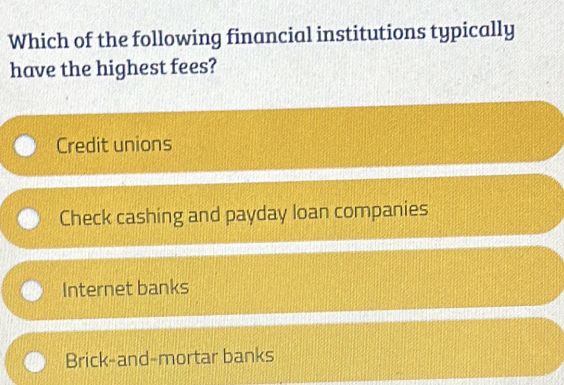
Which of the following financial institutions typically have the highest fees?
- A. Credit unions
- B. Check cashing and payday loan companies
- C. Internet banks
- D. Brick-and-mortar banks
The correct answer is B. Check cashing and payday loan companies. These businesses charge significantly more than banks or credit unions because they target consumers who need immediate cash and often lack access to traditional banking services. The fees and interest rates they impose can far exceed what any other type of financial institution charges for comparable services.
Why Check Cashing and Payday Loan Companies Charge the Most
Check cashing and payday loan companies operate on a fundamentally different business model than banks or credit unions. A traditional bank earns revenue primarily from the spread between deposit interest rates and loan interest rates. These companies, by contrast, earn almost all their revenue from fees charged on individual transactions — and those fees are steep.
A check cashing store typically charges 1% to 12% of the check’s face value just to convert it to cash. On a $1,000 paycheck, that could mean paying $10 to $120 for a service a bank account holder gets for free. Payday loans are even more costly. A common structure is a $15 fee per $100 borrowed for a two-week term. That translates to an annual percentage rate (APR) of roughly 390% — compared to 6%–36% APR on a typical personal loan from a bank or credit union.
The reason these fees stay so high is the customer base. People who use payday lenders often have no bank account, a low credit score, or an urgent need for cash before their next paycheck. With few alternatives and pressing bills, they accept terms that would be unthinkable in mainstream banking. This cycle can repeat: the Consumer Financial Protection Bureau has found that the majority of payday loans are rolled over or followed by another loan within 14 days, multiplying total costs further.
Why the Other Options Are Incorrect
Brick-and-mortar banks (D) are the most tempting wrong answer. Traditional banks do charge monthly maintenance fees, ATM fees, overdraft fees, and wire transfer fees. These can add up, and many people associate “high fees” with their everyday bank. However, even the most fee-heavy checking account rarely approaches the cost structure of a payday loan. A typical overdraft fee is around $35 per occurrence; a monthly maintenance fee might be $12–$15 and can often be waived by maintaining a minimum balance. Expensive, but nowhere near a 390% APR.
Credit unions (A) are member-owned, nonprofit cooperatives. Their structure means profits go back to members in the form of lower fees, higher savings rates, and lower loan rates. On average, credit union fees are among the lowest of any financial institution. They are essentially the opposite end of the fee spectrum from payday lenders.
Internet banks (C) operate without physical branches, which dramatically cuts overhead costs like rent, utilities, and staffing. They pass those savings on to customers through minimal or zero monthly fees, free ATM networks, and competitive interest rates. Many online banks charge no maintenance fee at all. They are consistently among the cheapest options for consumers.
Why This Question Matters Beyond the Classroom
Understanding which institutions charge the highest fees is a core concept in personal financial literacy. Payday lending is legal in most U.S. states, and these storefronts are often concentrated in lower-income neighborhoods. Recognizing the true cost of these services helps consumers make informed decisions. A single payday loan may seem like a quick fix, but the data shows borrowers frequently end up paying more in fees than the original amount they borrowed.
Financial regulators, including the CFPB and various state agencies, have attempted to cap payday loan rates or require clearer disclosures. Some states — such as New York, New Jersey, and Arizona — ban payday lending outright or impose strict rate caps. Knowing these facts equips consumers to seek alternatives: a small personal loan from a credit union, a paycheck advance program from an employer, or even a credit card cash advance (which, despite its own high APR of 20%–30%, is still far cheaper than a payday loan).
Quick Tip to Remember This Answer
Think of it this way: the more “alternative” and less regulated a financial service is, the higher the fees tend to be. Banks and credit unions are heavily regulated, federally insured, and compete for long-term customers. Check cashing outlets and payday lenders serve one-time, urgent transactions with minimal competition pressure. When a question asks about the highest fees among financial institutions, look for the option that operates outside the traditional banking system — that is almost always the most expensive choice.
