
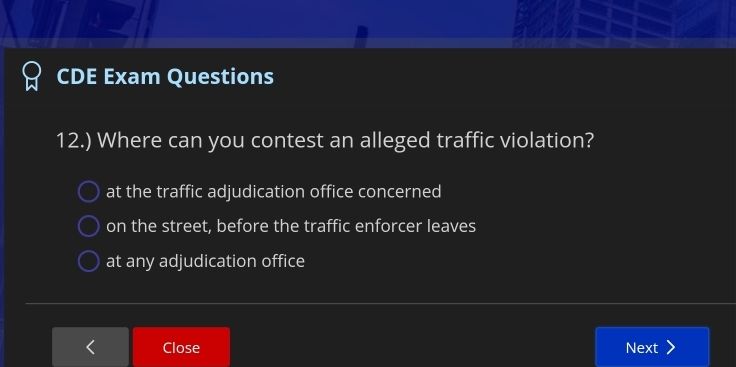
Where can you contest an alleged traffic violation?
A. At the DMV
B. At the police station
C. In court
D. At the insurance company
The correct answer is C. In court. When you receive a traffic ticket and believe the charge is unfair or incorrect, the legal venue for disputing it is a traffic court (or the relevant municipal, district, or county court with jurisdiction over traffic offenses). Courts are the branch of government authorized to hear evidence, weigh arguments from both sides, and render a binding verdict on whether a violation actually occurred.
Why Court Is the Correct Place to Contest a Traffic Violation
Traffic violations are governed by law, and any dispute about whether a law was broken must be resolved through the judicial system. When a police officer issues a citation, it is essentially an accusation — not a final ruling. The officer is part of the executive branch, which enforces laws; the court is part of the judicial branch, which interprets and adjudicates them. This separation of powers is fundamental in legal systems across the United States and most other countries.
After receiving a ticket, you typically have the option to pay the fine (which counts as an admission of guilt) or plead not guilty and request a court hearing. At the hearing, a judge reviews the evidence — the officer’s testimony, any dashcam or bodycam footage, speed-detection device calibration records, photographs, and your own testimony or that of witnesses. The judge then decides whether the prosecution has proven the violation. If the evidence is insufficient, the case can be dismissed entirely.
Many jurisdictions operate dedicated traffic courts specifically designed to handle the high volume of these cases efficiently. In smaller areas, a general municipal or district court handles traffic matters on scheduled docket days. Either way, the courtroom is where your right to due process — the right to be heard, present evidence, and challenge the accusation — is protected by law.
Why the Other Options Are Incorrect
A. At the DMV — The Department of Motor Vehicles handles licensing, vehicle registration, and administrative actions like license suspensions or point accumulations. It does not hold hearings to determine guilt or innocence for a specific traffic ticket. You might interact with the DMV after a conviction (for example, to attend a defensive driving course to reduce points), but the DMV cannot overturn or dismiss a citation. This is the most commonly confused answer because people associate the DMV with “all things driving,” but its role is administrative, not judicial.
B. At the police station — Police officers issue citations, but the police department has no authority to adjudicate them. Going to the station to argue about a ticket will not result in the ticket being dropped. Officers enforce laws; they do not serve as judges. In some cases, you can request a meeting with a supervising officer to discuss concerns about the stop itself, but that process does not replace a court hearing and cannot legally void the citation.
D. At the insurance company — Insurance companies deal with premiums, claims, and coverage. They have zero authority over traffic law. A conviction may cause your insurer to raise your rates, but the insurer plays no part in deciding whether you committed the violation in the first place. Contacting your insurance company about a ticket is relevant only after the legal outcome has been determined.
What Happens When You Go to Traffic Court
Understanding the actual process removes much of the anxiety around contesting a ticket. First, you enter a plea of not guilty, usually by mail, online, or in person before a set deadline printed on the citation. The court then schedules a hearing date. On that date, the citing officer must appear to testify; if the officer does not show up, many judges dismiss the case outright, though this is not guaranteed.
You have the right to cross-examine the officer, challenge the accuracy of speed-measuring equipment, question whether traffic signs were properly posted, or argue that your actions were legally justified (for example, moving into a bus lane briefly to avoid an emergency vehicle). If found not guilty, the ticket is dismissed and no fine or points apply. If found guilty, you may still have options: some courts allow traffic school to keep the conviction off your record, and you can often appeal the decision to a higher court within a specified number of days.
Hiring an attorney is optional for most traffic violations, but it can be worthwhile for serious charges like reckless driving, where penalties may include license suspension or even jail time.
Quick Tip to Remember the Answer
Think of it this way: tickets are accusations, and only a court can judge accusations. The DMV registers, police enforce, insurers calculate risk — none of them hold trials. Whenever a question asks where can you contest an alleged traffic violation, the word “contest” is a legal action, and legal actions happen in court. Linking “contest” with “court” — both start with “co” — is a simple mnemonic that works every time.
